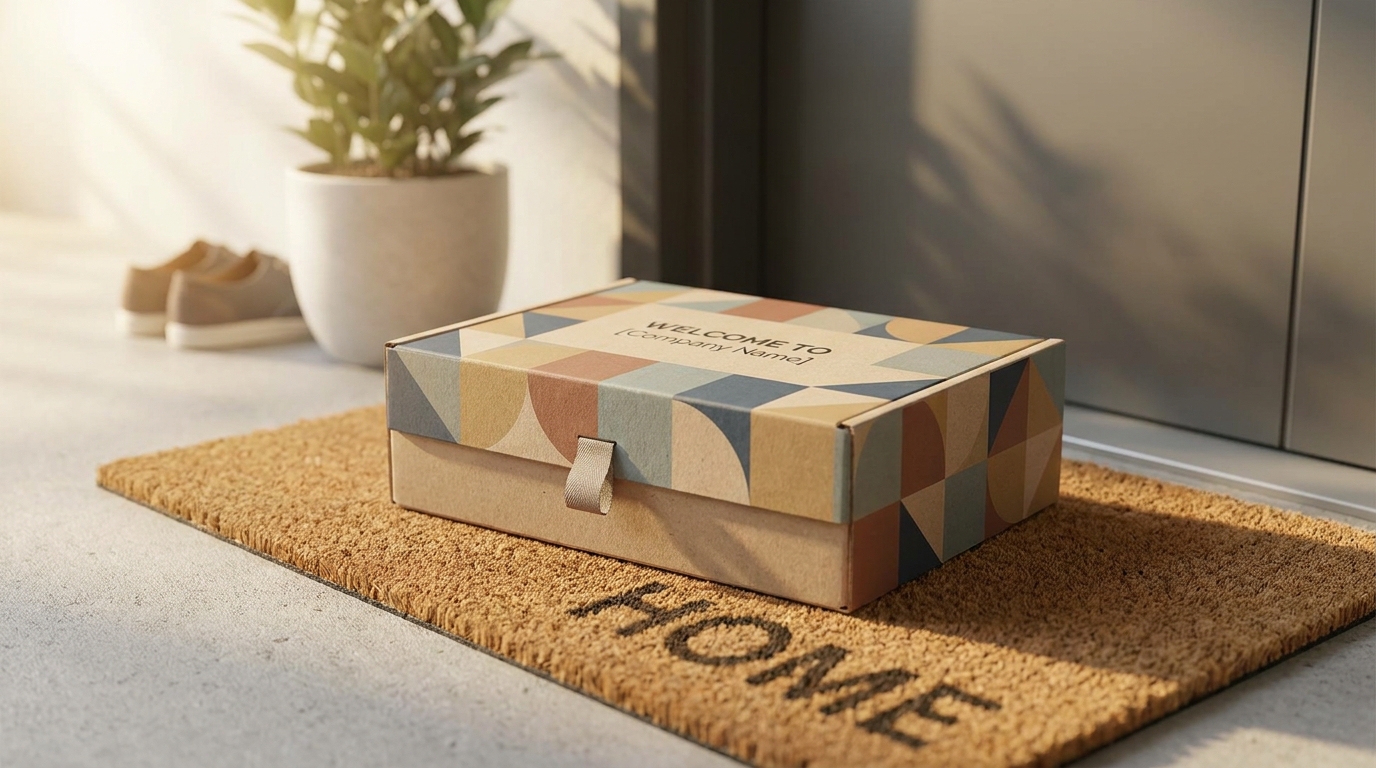
The kit isn’t a gift. It’s the first operational signal a new hire gets about whether the company has its act together. And when it shows up on day twelve, it tells a louder story than anything inside the box.
The day-one moment is non-negotiable
A new hire kit that arrives the morning of day one does a specific job. It says: we knew you were coming, we prepared, you belong here. The branded notebook, the swag, the handwritten card — none of that is the point. The point is that the company executed.
A kit that arrives in week two does a different job. It’s a souvenir. The new hire has already formed an opinion about how the company runs. They’ve already had the awkward first standup with no laptop sticker, no branded mug, no anything. The late kit becomes a “welcome back” gift instead of an onboarding signal. Same items, completely different artifact.
Talent leaders running onboarding at scale know this intuitively. The first 24 hours set the tone. Everything that follows is either reinforcing that tone or fighting it.
Late kits are a workflow problem, not a merch problem
Here’s what we see when we audit a broken new hire kit program. The merch isn’t the issue. The vendor relationships aren’t the issue. The kit contents are usually fine.
The breakdown is upstream:
- HR doesn’t know who’s starting until five days out, sometimes less.
- Ops doesn’t have the home address, the t-shirt size, or the role.
- The kit gets sourced and assembled from scratch every single time someone is hired.
- By the time the box is built and shipped, the new hire has already had their first week.
Sourcing items, branding them, and assembling a kit from scratch takes time. If that work starts the day a start date is confirmed, the kit will not arrive on day one. It can’t. The math doesn’t work.
The fix is to flip the sequence. The kit program — the box, the items, the inserts, the packaging, the inventory — needs to exist before any individual hire is in the system. When HR adds a new hire and an address, the kit ships. It doesn’t get built. It gets shipped.
That’s the difference between a program and a project. A program is designed once, sourced once, kitted into ready-to-ship inventory, and triggered per hire. A project starts over every time.
What’s in the kit is a design problem
Once the workflow is solved, the actual contents become the interesting question. And contents are a design problem, not a logistics one.
A sales rep kit should not look like an engineer kit. The sales rep needs branded items they’ll bring into client meetings. The engineer needs desk gear and quality basics they’ll actually use. A remote hire in a one-bedroom apartment needs different things than a hire walking into a downtown office on Monday morning.
This is where most catalog-style kit vendors fall short. They sell you a SKU. You pick from a list. Every new hire at every company gets a variation of the same box.
That’s not a kit. That’s a care package.
How we approach it
Our in-house kit designer, Jordan, builds these per client. Branded box. Branded items. Role-appropriate contents. Remote-vs-in-office variants when the program needs them. The design happens once, up front, before anyone is hired against the program.
That up-front design work is what makes the day-one ship possible. The decisions are already made. The inventory is already sitting in the kitting facility. When a name and address come in, the kit ships the same day or the next.
Three questions to pressure-test your current kit program
If you’re running onboarding and you’re not sure whether your kit program is actually working, three questions will tell you:
- What percentage of your new hires get the kit on day one? Not in the first week. On day one. If you don’t know the answer, the answer is probably “not many.”
- How many days of lead time do you need from start-date confirmation to ship? If the answer is more than three, the kit is being built reactively, not triggered from inventory.
- Does a sales hire get the same kit as an engineering hire? If yes, the kit is doing one job — branding — when it could be doing two.
None of these questions are about budget. They’re about whether the program is designed for the moment it’s supposed to land.
What changes when the kit lands on day one
This isn’t about employee delight metrics. It’s about what the new hire concludes about the company in the first eight hours.
When the kit is on the doorstep the morning they log in, the conclusion is: this place is organized, they were expecting me, the systems work. That conclusion gets reinforced by the laptop arriving on time, the calendar invites being correct, the manager actually being available.
When the kit is missing on day one, the conclusion is: I’ll see what else slips. And then the new hire starts noticing every other thing that slips, because they’re already looking for it.
The kit is small. The signal isn’t.
Where to start
If your current kit process starts with “someone signs an offer” and ends with “we hope it ships in time,” the program needs to be redesigned around inventory and triggers, not orders and assembly. That’s the work.
Running onboarding for 50+ hires this year? See how we build new hire kits that ship day one →