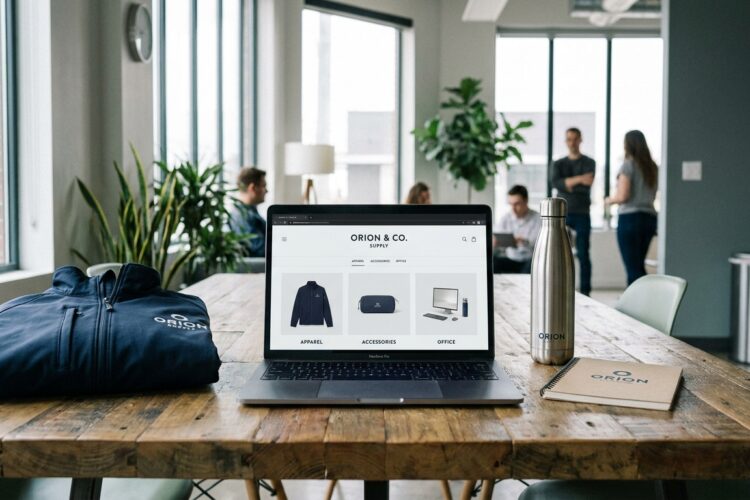

The corporate merchandise landscape is shifting dramatically. Traditional branded swag stores that require upfront inventory investments are giving way to on-demand fulfillment models that deliver superior ROI and employee engagement.
Brand On Demand represents a fundamental reimagining of how companies approach corporate merchandise, employee rewards, and branded materials. Instead of warehousing inventory and managing logistics internally, smart marketing teams are leveraging no-inventory platforms to reduce costs while expanding product selection.
The Capital Efficiency Advantage
Traditional corporate stores require significant upfront capital investment. Companies must purchase inventory in bulk, often committing thousands of dollars to products that may sit unused for months or even years.
According to the National Retail Federation, the average inventory carrying cost runs between 20-30% of inventory value annually when factoring in warehousing, insurance, obsolescence, and opportunity costs. For a mid-market company with $50,000 in branded merchandise inventory, that represents $10,000-$15,000 in hidden annual costs.
Brand On Demand eliminates these carrying costs entirely. Products are manufactured and shipped only when ordered, turning inventory expense into a variable cost that scales directly with demand.
Expanded Selection Drives Higher Engagement
No-inventory models enable dramatically larger product catalogs. While traditional corporate stores might offer 20-50 items due to inventory constraints, Brand On Demand platforms can provide hundreds or thousands of options.
This expanded selection directly impacts employee engagement. Research from the Society for Human Resource Management shows that 68% of employees value choice in workplace benefits and perks. When employees can select from a broader range of branded merchandise that aligns with their personal preferences, redemption rates increase significantly.
Companies using no-inventory platforms report 40-60% higher engagement rates compared to traditional fixed-inventory stores, according to industry data from promotional products associations.
Reduced Waste, Improved Sustainability
Traditional inventory models generate substantial waste. The Promotional Products Association International estimates that 15-25% of promotional products purchased in bulk are never distributed, representing both financial loss and environmental impact.
Brand On Demand eliminates overstock waste entirely. Every item produced has a confirmed recipient, reducing environmental impact while improving cost efficiency. For companies with sustainability initiatives, this waste reduction provides measurable environmental benefits that align with corporate responsibility goals.
Real-Time Performance Analytics
No-inventory platforms provide detailed analytics that traditional stores cannot match. Marketing teams gain visibility into:
- Real-time redemption patterns by department, location, or employee segment
- Popular product categories and trending items
- Cost-per-engagement metrics across different merchandise types
- Regional preferences and seasonal demand fluctuations
This data enables continuous optimization of merchandise strategies, ensuring higher ROI over time.
Operational Simplification
Managing traditional corporate stores requires significant internal resources. HR and marketing teams spend hours processing orders, managing inventory levels, coordinating shipments, and handling storage logistics.
Brand On Demand platforms handle fulfillment, quality control, and shipping automatically. This operational efficiency allows marketing teams to focus on strategy and employee experience rather than logistics management.
Companies typically see 60-80% reduction in administrative time spent on merchandise management when switching to no-inventory models.
Scalability for Growing Organizations
Mid-market companies face unique challenges when scaling corporate merchandise programs. Traditional inventory models require proportional increases in storage, capital, and management resources as organizations grow.
Brand On Demand scales seamlessly without infrastructure investment. Whether serving 250 employees or 5,000, the platform handles increased volume without additional internal resources or complexity.
Quality Control and Brand Consistency
Contrary to common misconceptions, on-demand fulfillment often delivers superior quality control. Leading Brand On Demand providers maintain strict quality standards and brand guidelines, with each item produced to order using consistent materials and printing specifications.
Traditional bulk orders may sit in storage for months, potentially degrading in quality or becoming outdated as brand guidelines evolve. On-demand production ensures fresh merchandise that reflects current brand standards.
Implementation Best Practices
Successful Brand On Demand implementation requires strategic planning:
- Curate thoughtfully: While selection can be vast, create focused collections that align with your brand values and employee preferences
- Set clear budgets: Establish per-employee allowances or event-specific budgets to control costs while maintaining engagement
- Monitor and optimize: Use platform analytics to identify popular items and adjust offerings based on actual usage data
- Communicate value: Help employees understand the expanded options and personalization benefits of the new system
The Future of Corporate Merchandise
Brand On Demand represents more than a tactical shift—it’s a strategic evolution toward more efficient, engaging, and sustainable corporate merchandise programs. As companies increasingly focus on employee experience and operational efficiency, no-inventory models deliver measurable advantages across multiple dimensions.
Marketing leaders who embrace this transition position their organizations for improved ROI, higher employee satisfaction, and reduced operational complexity. The question isn’t whether to make this transition, but how quickly your organization can capitalize on these advantages.